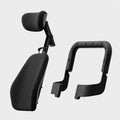
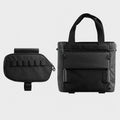
RT.3
For everyone who walks themselves and wants to steer less on sloping sidewalks.
Explore walking support
Would you like support while walking, to continue driving yourself when exhausted, or to be pushed on the go? This is where the RT.3, ROMIRO ONE, and Roamate differ.
For everyone who walks themselves and wants to steer less on sloping sidewalks.
Explore walking support
For everyone who wants to walk as long as possible and be able to turn around and sit down immediately to continue their journey.
See how to switch to riding
For everyone who wants to use a foldable electric wheelchair also as a rollator or with an accompanying person.
Explore the three modesRollators for walking and riding in a seated position
All three models are foldable. The dimensions are given in the order of length × width × height.
| Model | Folded dimensions | With battery | User weight up to | Bag or basket |
|---|---|---|---|---|
| RT.3 | 65 × 26 × 77.5 cm | approx. 10 kg | 100 kg | 9 liters, max. 5 kg |
| ROMIRO ONE | 65 × 26 × 84 cm | approx. 14 kg | 120 kg | approx. 5 kg recommended |
| Roamate | 48 × 37 × 80 cm | approx. 18.5 kg according to shop specifications | 110 kg | max. 10 kg, basket optional |
When space is tight. For the ONE, the shop states a folded length of 65 cm, while the manual states 60 cm. Plan for 65 cm. For the Roamate, the German manufacturer's manual states 48 × 37 × 80 cm, while the German short version states 50 × 35 × 80 cm. The weight also varies. The shop states 17 kg without the battery plus a 1.5 kg battery, while the manufacturer's manual states 17 kg as the total weight. If the opening or lifting limit is tight, it is worth trying it with the actual device.
Will my device fit in the car boot? Compare all models and lifting weights
When the sidewalk slopes down towards the street. While you guide the RT.3, the two separately driven rear wheels compensate for lateral pull. You can walk straight more easily. Uphill, the motor increases the push assistance; downhill, the braking assistance engages. This switches automatically while walking, even with groceries in the front basket.
If you let go or the speed suddenly increases. The sensor on the right handle detects when your hand loses contact. The switched-on RT.3 then brakes independently to a standstill. Excessive speed or too rapid acceleration also trigger braking. Propulsion, downhill braking, speed threshold, and volume can each be set in four stages.
What the RT.3 tells you. After walking for a long time, it suggests taking a break. When switched off, it states the distance traveled since the last switch-on in meters. At the touch of a button, you can hear the total distance traveled in kilometers. It also alerts you to a low battery level, excessive tilt, lifted front wheels, and the device tipping over.
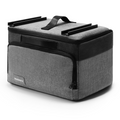
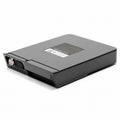
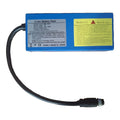
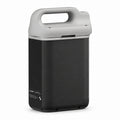
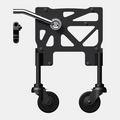
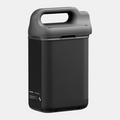
For shopping and at home. The front basket holds nine liters. The 240 g battery fits in one hand. You can take it into the apartment with you and charge it there in the charging cradle. The handles can be adjusted to seven heights. The seat is designed for breaks while standing still.
At the shop door. Guide the RT.3 up the ramp with both hands. To open the door or take a seated break, choose a level spot and engage both locking brakes. Switch off the device before sitting down. Use the RT.3 on paths with a slope of less than 7° along the path and less than 3° across it.
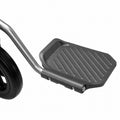
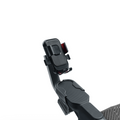
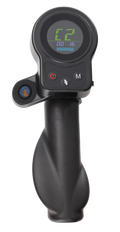
When you run out of strength halfway along the way. You walk as if with a classic rollator. On level ground, stop, engage the locking brakes, turn around on the spot, and sit down facing the direction of travel. There is no need to walk around the device. While seated, extend the side-mounted footrests by pressing them out, remove the joystick from its magnetic holder, and insert it into the right or left end of the handle. To set off, release the locking brakes. Using the joystick, you can continue driving at speeds of up to 6 km/h. An accompanying person can also push you.
What the optional push and brake module adds. When walking, it assists uphill and automatically brakes downhill. For additional consistent propulsion, keep the thumb button pressed, for example on an uphill path coming out of an underpass. The hand sensor detects when you let go and brakes. After five seconds without hand contact, the push function locks. To continue walking, place your hand back on the handle and briefly press a button. The joystick driving function is already part of the basic equipment.
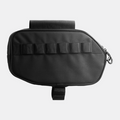
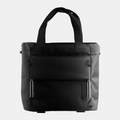
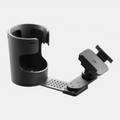
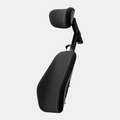
Which bag for what? Groceries go into the large, covered bag with a zipper. The optional comfort back strap has a zipper pocket close to the hand with an additional inner pocket for a mobile phone, keys, or wallet. The two side pockets are intended for the battery and controls.
Walk, drive, or be pushed. Walk behind the switched-on Roamate, drive while seated using the joystick at speeds of up to 6 km/h, or be pushed by an accompanying person. In walking mode, it adjusts the assistance uphill and the resistance downhill. For consistent propulsion on straight stretches, you or your accompanying person keep the Boost button pressed. You can choose 1, 2, or 3 km/h.
Stopping in driving mode. Release the joystick, and it returns to the center. With the drive brakes locked, the Roamate stops, and the electromagnetic brake holds it in place. Voice prompts indicate, among other things, steep inclines or a low battery level.
Handy on the go. The optional basket is located under the seat. This allows you to access a drink, snack, or charger during a break, even while seated. For long excursions, there is space for a securely packaged spare battery. The removable battery has a range of around 20 km and can be charged at home.
Measure the narrowest opening of the car boot, the usable depth and width, and the height of the loading edge. Also check the space between the wheel arches. A box in the folded dimensions will show whether the device fits through the opening. Whether you can lift it over the loading edge yourself is best tested with the demonstration model and your own car. Our team also takes devices in small cars for demonstrations.
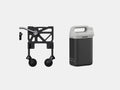
This is how the models fold. With the RT.3, hold the frame and pull the loop on the seat. With the ONE, the seat handle can be pulled up with one hand. Both become 26 cm narrow. With the Roamate, fold down the backrest and footrests, release the rear lock, pull the seat handle, and bring the sides together until they click into place. Then fold down the push handles and attach the elastic transport strap. It holds the device folded.
Remove shopping before lifting. With the RT.3, also remove the battery for car transport. Guide the device close to your body, turn it with your feet, and lift it with two people if necessary. Place the Roamate flat in the car boot according to the instructions. The joystick and footrests are not suitable as carrying handles.
Store heavy items low and close to the rear seatback. Secure the device against movement in all directions with suitable straps to the designated tie-down points, according to the vehicle instructions. In a five-door car, the footwell behind the driver's or passenger's seat is also an option, provided the device fits inside and can be secured according to the vehicle instructions. Wedging it in with the front seat or using a standard seat belt alone is not a reliable cargo tie-down for a rollator. A blanket protects the upholstery. For wet or sandy wheels, a small hand brush and a damp cloth in the car are useful.
RT.3. Remove the small battery and charge it in the separate charging cradle. ROMIRO ONE. The permanently installed standard battery charges on the device. With the removable battery option, you can choose between charging on the device and external charging with the provided adapter. Roamate. Switch off the battery, remove it, and charge it directly with the original charger, as specified in the German manual.
If your rollator has to stay in the building entrance or garage and no socket is available there, the battery option makes a big difference in everyday life.
If one battery covers your usual routes, it is generally sufficient. For a long visit with friends, you can pack the original charger and plan a charging break. For regularly long distances without a socket, a second battery can be useful. Mark them A and B and use them alternately.
Before recharging, you do not need to deliberately drain the battery. For everyday use, the ONE recommends keeping the charge between 20–80% as much as possible, 40–60% for longer storage, and checking it approximately every three months. For the RT.3, the manufacturer recommends recharging monthly for longer storage. For the Roamate, it recommends storing the switched-off battery separately in a cool, dry place. Disconnect the charger after charging according to the respective manual.
This information is helpful for registering with the airline. RT.3 has a removable battery with 46.8 Wh, which ROMIRO ONE with removable battery has 120 Wh and the Roamate 252 Wh. For the ONE, the manual specifies the removable battery option for air travel.
Have your airline confirm the device and battery in advance. Clarify the disassembly, carriage in the cabin, and any spare battery. Protect exposed batteries against short circuits and damage according to the airline's requirements.